How to Recognize Good Drilling Without Holding the Pipe in Your Hand
Buying a pipe online always requires a little trust. Photos can show a great deal, but they cannot replace the feel in the hand, the character of the draw, or the comfort of the stem between the teeth. Still, that does not mean you are buying blind. Good drilling leaves clues that can be read in photographs, technical specifications, and in the way a pipe is presented. This guide does not promise miracles. It shows what can honestly be judged from a distance, and what remains uncertain until the pipe is actually in your hand.
Why drilling matters more than it first appears
When people first look at a pipe, they usually notice the shape, the finish, or the grain. A more experienced eye quickly moves to less glamorous things: how the airway is drilled, where the draft hole enters the chamber, how the stem meets the shank, and whether the entire construction feels coherent. That is often where the difference lives between a pipe that photographs beautifully and one that will actually smoke in a calm, reliable, satisfying way.
When we talk about drilling, we do not mean merely the existence of a hole through the pipe. We mean the geometry of the whole path that smoke and air travel, from the chamber through the shank and into the stem. When that path is executed well, a pipe tends to feel orderly and easy in use. When it is not, the smoker often notices resistance, Moisture in the wrong places, awkward maintenance, or the sense that the pipe asks for more effort than it should.
What can really be judged online
Buying online is not the same as examining a pipe in person, but it is not pure guesswork either. A strong presentation reveals more than many buyers realize. Clear photographs from several angles, a visible chamber, a proper view of the stem junction, and accurate dimensions already provide a solid starting point for judging whether the maker or seller treats the pipe seriously.
The first thing worth checking is whether there is a chamber photo clear enough to suggest where the draft hole enters. You cannot always make a perfect judgment, but you can often see whether it appears implausibly high, too low, or roughly where it ought to be. If no image helps at all, then the buyer does not have evidence, only assumption.
The second thing is the meeting point between shank and stem. Even without handling the pipe, the neatness of the transition, the seating of the stem, and the general impression of precision can say a great deal. When a pipe looks as though bowl, shank, and stem were conceived as one coherent object, that is usually a better sign than a pipe whose details only look acceptable from a polite distance.
The chamber view: a small detail worth a great deal
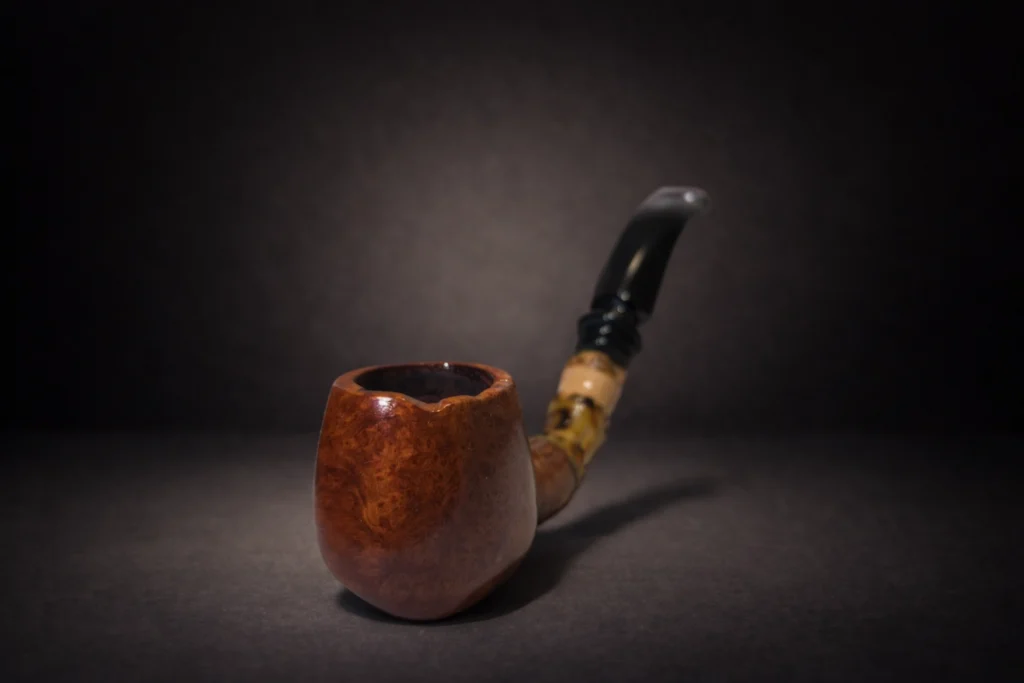
A photograph of the chamber is one of the most useful elements in an online listing. Not because it reveals everything, but because it separates serious presentation from superficial presentation almost immediately. When the chamber is shown clearly enough, you can pay attention to a few important things: does the bottom look clean and deliberate, does the draft hole appear sensibly placed, and does the interior suggest control rather than improvisation?
It is important to stay honest here. Not every chamber photo allows a firm conclusion that the drilling is excellent or poor. Camera angle, shadow, and chamber depth can all mislead the eye. But you can often recognize when a seller or maker is not hiding the important parts. That alone is a sign of confidence. Someone willing to show the chamber clearly usually has no fear of letting the buyer inspect what matters beyond the glamour shots.
Why technical specifications are not just dry catalog language
Many buyers skip the measurements and go straight to the photo gallery. That is understandable, but rarely wise. Chamber diameter, chamber depth, overall length, bowl height, and weight are not mere administrative details. They tell you how the pipe may sit in the hand, how long a smoke it is likely to favor, and what sort of tobacco cut or smoking cadence might suit it naturally.
When precise measurements are listed alongside the images, it usually signals a serious approach to presentation. When even the basics are missing, the buyer is forced to guess. Guesswork is a poor companion when judging a pipe, especially if one is also trying to evaluate the logic of the drilling and the engineering as a whole.
How to read a product description without being seduced by beautiful prose
A good description does not have to be cold, but it should say something concrete. If the text offers only mood, atmosphere, and broad praise, while telling you nothing about the chamber, weight, filter system, stem material, or construction choices, then it is not giving the buyer what the buyer actually needs. Beautiful writing may accompany a good pipe, but it cannot replace useful information.
So it helps to look for sentences that reveal real attention to the object itself: what the stem is made from, whether the pipe takes a filter, how large the chamber is, how the pipe is intended to feel in use. The more specific the description, the less you must rely on imagination. And online buying is often a struggle against the empty spaces imagination fills too quickly.
Red flags worth taking seriously
Some things do not prove a pipe is bad, but they do justify caution. The first is a poor photo set: only one or two angles, no chamber view, and no clear image of the stem. The second is a complete absence of technical measurements. The third is a description that speaks only about appearance and says nothing meaningful about function.
Another warning sign is the feeling that the camera never comes close to the places where quality would actually show: the chamber, the stem junction, the transition from shank to stem. A serious maker or a serious seller does not need to hide the very parts where quality is often most visible. The issue is not perfection. The issue is whether the buyer is allowed to look where the buyer ought to look.
What cannot honestly be known without handling the pipe
This is where it helps to slow down. Even the best photographs cannot give you the true character of the draw. They cannot fully reveal how the stem feels between the teeth, how comfortable the button is, how smoothly a pipe cleaner passes through the system, or how the pipe behaves after half an hour of actual smoking. These are not flaws of online buying. They are simply the limits of distance.
That is why it helps to distinguish between two kinds of judgment. The first is a reasonable judgment: “Based on the images and the specifications, this pipe appears thoughtful and technically serious.” The second is false certainty: “I know for sure this pipe will smoke perfectly.” That second sentence is rarely honest online. A good purchase does not require impossible certainty. It requires enough trustworthy signals to make the decision sensible.
Useful questions to ask before buying
When something is unclear, the best move is to ask briefly and precisely. There is no need to perform expertise or bury the maker in jargon. A few practical questions are enough: does a cleaner pass easily to the chamber, where exactly does the draft hole emerge, does the pipe take a filter or adapter, how does it feel in a clench, and is there an additional image of the chamber and stem junction?
A good answer does not need to be long. It only needs to be calm, clear, and specific. And that is often where the difference becomes visible between someone who truly knows the object and someone who merely knows how to sell an image of it.
Online you are not buying certainty, but honest probability
The healthiest approach to buying a pipe online is not a hunt for absolute certainty, but a search for honest signs of quality. Good drilling leaves traces: in the chamber view, in the logic of the construction, in the neatness of the stem fit, in the measurements, and in the willingness to show important details instead of hiding them.
That may not sound romantic, but it is useful. And with pipes, what is useful often turns out to be the most beautiful thing. Because once the object stops being just a photograph and becomes a real companion in smoking, what remains is not the marketing impression but the quality of the choice you made.