A Guide to Pipe Tobaccos: Types, Cuts, Moisture, and How to Choose What Suits You
If the world of pipe tobacco feels full of terms, descriptions, and uncertainty, this guide is your main map. It explains the main tobacco types, the differences between cuts, the importance of moisture, and how to choose tobacco according to your own rhythm rather than someone else’s habits.
Why choosing tobacco often feels confusing
The world of pipe tobacco often looks far more complicated at the beginning than it really is. A beginner opens a few descriptions, reads a few recommendations, and very quickly runs into the same fog: Virginia, Burley, Kentucky, Latakia, Perique, Cavendish, Aromatic, English, ribbon, flake, ready rubbed, moisture, nicotine strength, room note, tongue bite. The problem is not that these terms are meaningless. The problem is that they often arrive all at once, without any order.
And without order, even a good tobacco can become a poor first impression. Someone buys a blend because the description sounds beautiful, but does not realize that the cut asks for more patience than they currently have. Someone chooses by tin aroma and then feels disappointed because the taste in the pipe is not the same. Someone believes a certain tobacco type does not suit them, when the real problem was moisture, not the blend. That is why this guide is designed as a starting map. Not to replace experience, but to help you read it more clearly.
Beginners often think they are choosing only flavor. In practice, you are choosing at least four things at once. You are choosing the basic tobacco profile, the way the tobacco has been cut and prepared, the degree to which it is ready for your present technique, and the level of strength and character you want to handle. In other words, you are not only choosing what sounds attractive, but also how friendly that tobacco will be in an actual pipe.
This is why two tobaccos can look similar on paper and behave completely differently in practice. One may be calm and clear at the start, while another only rewards you once you know what you are doing. One may smell inviting and still smoke in a demanding way. Another may look modest in its description and yet provide a cleaner, fairer experience. That is why it helps to learn tobacco in layers rather than as one single category.
Four things that change the experience most
A good pipe tobacco choice usually does not begin with the prettiest name or the most impressive recommendation, but with a few very concrete things that determine how the blend will behave in an actual pipe.
The first is the tobacco type. It determines the basic profile: more natural sweetness, earthier dryness, smoky character, spiced depth, or softness.
The second is the cut. The same blend does not behave the same way as ribbon, flake, coin, or ready rubbed. The cut changes preparation, lighting, and smoking cadence.
The third is moisture. A tobacco can be good, yet if it is too dry or too wet, the first impression can easily become misleading.
The fourth is strength. Flavor and nicotine strength are not the same thing. It is not enough to know whether you like the profile. It also matters whether the actual strength suits you.
Tobacco types: the skeleton of every blend
The first layer worth understanding is the main tobacco type, that is, the part of a blend doing the central work. Here you most often meet names such as Virginia, Burley, Kentucky, Latakia, Perique, and Cavendish. These names do not all give the same kind of information. Some speak more about the leaf itself, some about processing, and some about the role a component plays inside the blend.
The simplest way to think about this is the following: some tobacco elements form the foundation of a blend, while others act as an accent. The foundation determines the main direction of the experience. The accent changes tone, depth, smokiness, spice, or softness. Once you understand that, blend descriptions begin to work for you instead of against you.
Virginia: more natural sweetness and more light
Virginia is often a first serious encounter with the impression of the leaf itself. It often seems brighter, cleaner, and more naturally Sweet. That sweetness is usually not dessert-like, but closer to bread, hay, dried fruit, or gentle warmth. Virginia can be very rewarding for those who like clearer and tidier profiles, but it can also be sensitive if smoked too fast or if the blend is too moist.
In many mixtures, Virginia forms the foundation. It holds the structure and provides liveliness. That makes it useful not only as a flavor but also as a reference point: once you learn to recognize Virginia, many other blends become easier to read.
Burley: body, dryness, and a calmer character
Burley is often more grounded than Virginia. It can feel fuller, drier, nuttier, sometimes cocoa-like or woody. If Virginia often appears brighter and more lively, Burley tends to create a sense of quieter stability. That is why it often suits people looking for something less sweet and less decorative.
Burley is also useful because it teaches that a good tobacco does not have to be seductively sweet. Sometimes the more restrained, firmer profile is exactly what fits a smoker better.
Kentucky, Latakia, and Perique: darker, smokier, and spicier accents
When someone wants more weight, more depth, or a darker character, they quickly arrive at Kentucky, Latakia, and Perique. But these darker or stronger tobacco terms are not interchangeable. Kentucky often carries more roasted, robust heaviness. Latakia usually contributes a recognizable smoky signature. Perique most often works as a spicier, darker, or deeper accent used with more restraint.
Beginners often make the mistake of putting all darker tobacco language into one basket. But it matters whether you are looking for smoke, strength, depth, or simply less sweetness. These components should be read as different tools, not as one single class of “strong tobaccos.”
Cavendish: processing, softness, and a base for different directions
Cavendish is not simply one botanical tobacco variety. It is first of all a story of processing. That is why Cavendish often brings softness, roundness, and a gentler feel in the smoke. In many blends, it acts as a base that carries added aromas or smooths the edges of other components.
This is one reason why beginners often associate Cavendish with aromatics. The connection is real, but it is not absolute. Cavendish can belong to an Aromatic blend, but not every blend containing Cavendish is automatically a sweet aromatic.
How to read a blend quickly
When you read a blend description, first try to see which components are doing the main work. That often tells you more than the poetic notes themselves.
Virginia usually suggests more natural sweetness, more brightness, and more liveliness.
Burley more often brings dryness, body, and earthier or nuttier tones.
Latakia most often signals a smoky signature.
Perique usually adds spiced depth or a darker accent.
Cavendish often points to softness, roundness, and a gentler feel in the smoke.
Aromatic, non-aromatic, and everything in between
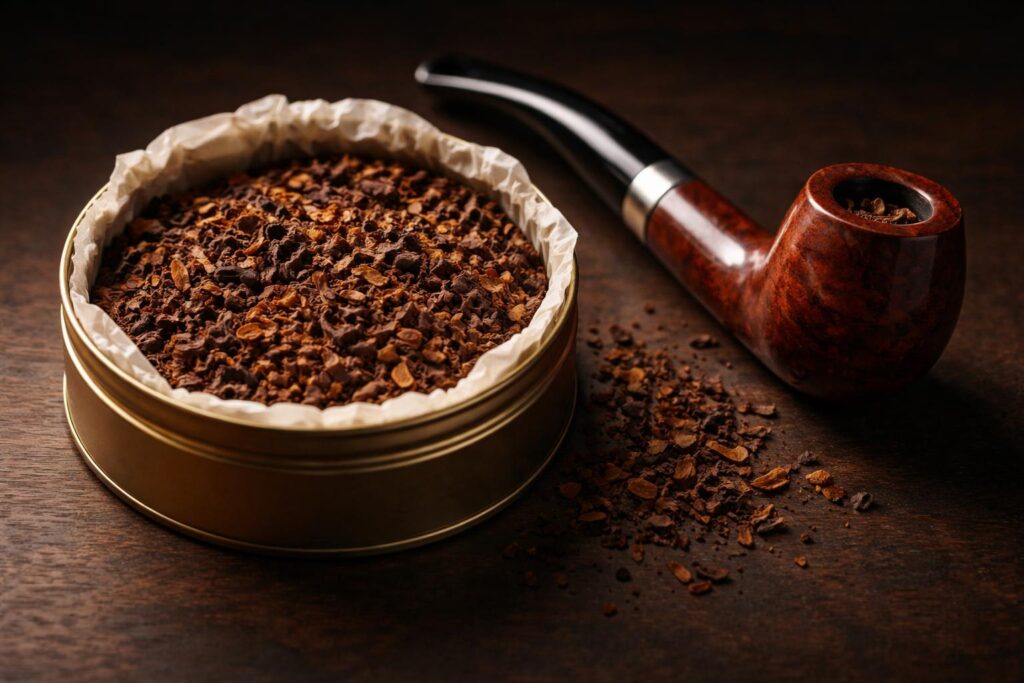
One of the first great divisions people learn is aromatic versus natural tobacco. It is helpful as a sketch, but it is not enough. In reality, there is a whole range between a clearly aromatic blend and a mixture that places almost all emphasis on the leaf itself. Some blends have only light additional treatment. Some carry a very obvious topping. Some smell extremely attractive in the tin but prove much calmer in the pipe.
The most important thing to remember here is simple: tin note, room note, and taste in the pipe are not the same thing. A tobacco that smells lovely before lighting may not speak in exactly the same way through the whole bowl. That is not a flaw. It only means that buying solely by the first aroma is risky, and that no Sweet note in a description should be expected to become a literal flavor in the smoke.
That is why it is more useful to ask whether the description speaks more about the leaf itself or more about an added aromatic layer. Only then do aromatic and non-aromatic stop being labels and become a practical tool for choosing well.
Tobacco cuts: the same blend, different behavior
The second major layer of the story is no longer the leaf itself, but the way the tobacco has been cut. Beginners usually meet ribbon and flake first, but the real world of cuts goes further: ready rubbed, broken flake, coin, plug, shag, and other forms. Cut is not just a visual detail. It directly changes how easily the tobacco takes flame, how much preparation it requires, and how fast or calmly it wants to burn.
This means you cannot judge a tobacco fairly if you ignore the cut. Some tobaccos look difficult only because they demand more preparation. Some look simple, yet forgive poor cadence less because they are cut more finely and respond more quickly. If a beginner does not see that, it is easy to conclude that the blend does not suit them, when what really does not suit them is the form in which they are meeting it.
Ribbon and ready rubbed: an easier beginning
For someone just entering the world of pipe tobacco, ribbon and ready rubbed are often among the most accessible cuts. They usually require less work before packing and often provide a clearer, more predictable entry. That does not mean they are always better, only that fewer things can go wrong before the pipe has even begun.
Flake, broken flake, coin, and plug: more control, more preparation
Flake and its related forms often offer a different rhythm. They can create a slower pace, more room for development, and more of a sense that the tobacco has layers. But this comes at a price: better moisture judgment, a little more preparation, and more feel for packing. Nothing about that is elite. It is simply a different tool for a different relationship with tobacco.
Shag: quick and sensitive
Shag appears easy because it lights quickly and asks for very little preparation. But precisely for that reason, it can be sensitive to hurried smoking. A fine cut that catches quickly can just as easily move toward faster and hotter smoking if not treated calmly. “Easy to prepare” does not always mean “easy to smoke.”
Which cut suits a beginner best
There is no single universal answer, but there is a practical order for beginners.
If you want an easier beginning, ribbon and ready rubbed are often the most forgiving.
If you want more feel for the tobacco and more control, broken flake, flake, and coin offer more room to learn.
If you want a quick and simple cut, shag can be practical, but it asks for a calmer cadence.
If you enjoy ritual and hand preparation, plug can be especially interesting, but it is not necessarily the best first step.
Moisture: the quiet line between a good and a poor impression
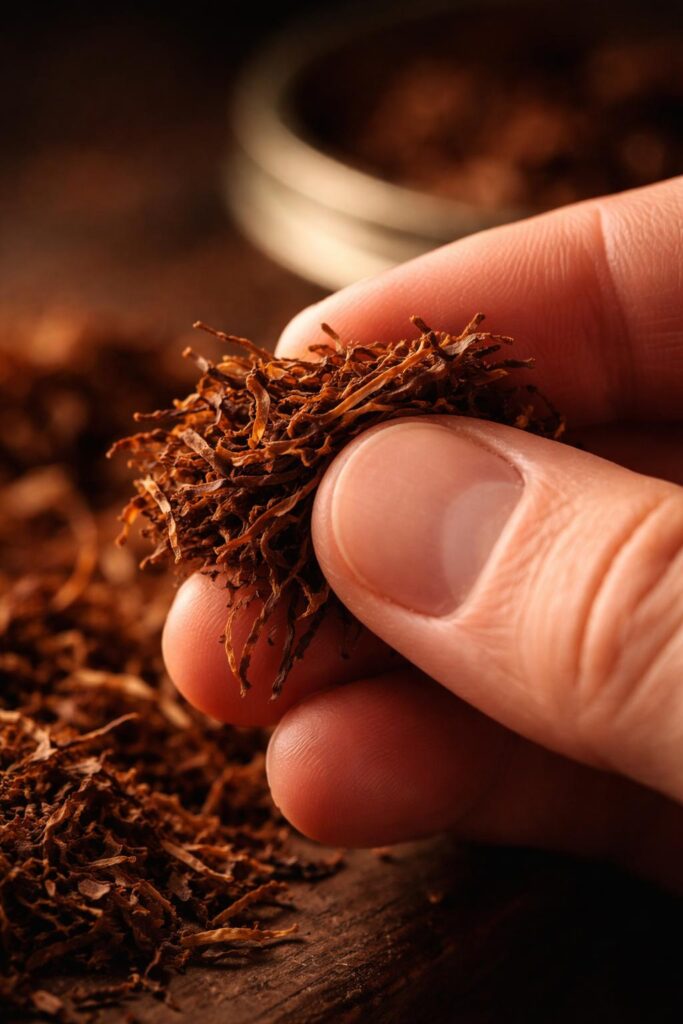
Many bad judgments about tobacco have nothing to do with the blend itself and everything to do with moisture. If the tobacco is too dry, it can feel empty, quick, and rough. If it is too wet, it can go out repeatedly, require too many relights, and leave an impression of heaviness or steam instead of a calm smoke. At that point, a beginner often thinks they do not know how to smoke, that the pipe is wrong for them, or that the tobacco is bad. Sometimes the problem begins before the first ember.
This is exactly why moisture deserves a place in a pillar article. Not as a laboratory obsession, but as a basic hygiene of good selection. It makes a difference whether you smoke the same tobacco straight from a newly opened tin, after a short drying time, or after leaving it open too long. Moisture changes both the behavior of the burn and the way flavor is perceived.
The simplest practical principle is this: tobacco should feel alive and flexible, but not sluggish and not sticky when ready to pack. Once you learn to recognize that, a whole range of blends suddenly begins to behave more honestly.
Strength is not the same as flavor
This is one of the most important things to understand if you want a calmer way of choosing tobacco. When someone says a tobacco is strong, they may not be speaking about the same thing you imagine. Sometimes they mean a darker or fuller taste. Sometimes they mean a smokier impression. Sometimes they mean nicotine strength. Those are not the same things. A tobacco can have a very expressive flavor without physically hitting you like a more nicotine-heavy blend. Likewise, something can seem gentle in aroma while being more serious in nicotine than a beginner expects.
That is why it helps to separate the question do I like this profile? from the question does this strength suit me? Only then does selection become more honest and safer.
How to choose a first tobacco without choosing blindly
The healthiest beginning is not to chase the best tobacco for beginners as though one universal answer existed. It is far more useful to ask what actually attracts you. Do you want a softer and more welcoming entry? Do you want something earthier and drier? Are you drawn to darker and smokier profiles? Once you know that, it becomes easier to choose a general direction first and only then a brand or a specific blend.
The second step is not to buy based on one beautiful word in a description. If you see vanilla, smoky, dark fruit, or English, that is still not enough. Look at the components, the cut, and the general reputation for ease or difficulty in smoking. That makes selection less of a romantic lottery and more of a reasonable first encounter.
The third step is not to take on too many different directions at once. Two or three well-chosen profiles often teach more than five random tins bought by mood.
Why the same tobacco behaves differently in different pipes
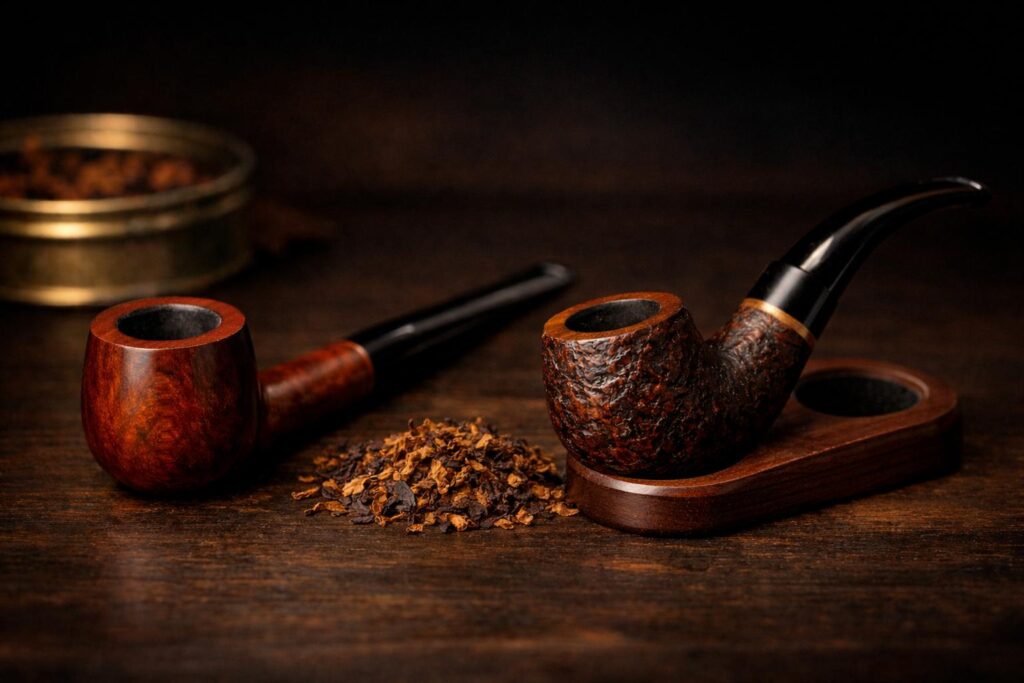
Another thing beginners quickly discover is that tobacco does not exist on its own. It is smoked in a particular pipe, in a particular chamber, with a certain airflow, with or without a filter, at a certain cadence. That is why the same blend may feel more open in One Pipe and drier, hotter, or more closed in another.
This does not mean you need to build a theory about mystical pairings between tobacco and pipes. It is enough to understand that the tool changes the reading of the blend. This matters especially when you are judging a tobacco you do not yet know. Sometimes the issue is not the blend, but the conditions in which you smoked it.
Flavor through the bowl: do not judge by the first flame
Beginners very often deliver a verdict too early. The first few puffs seem to give a clear enough signal: I like it or I do not. But a pipe rarely tells the whole story immediately. Many blends show a different beginning, a different middle, and a different ending. Some only open in the middle of the bowl. Some begin well and then lose their order. Some reveal deeper character near the heel.
That is why it is a good habit not to judge a blend by the first three draws. Give it enough space to reach at least the middle of the bowl before deciding that it is for you or not for you. This does not apply absolutely to every tobacco, but it applies often enough to save a beginner many false conclusions.
How to learn your own taste without hoarding tobacco
As soon as someone goes a little deeper into the subject, the question of storage appears. Should something be kept? For how long? In what? The answer should stay calm: not every tobacco needs to become an archive. Some mixtures really do make sense to revisit later, especially if you already know you enjoy them and want to see what time does. But hoarding blindly makes far less sense than first understanding what you actually like.
One of the best ways to stop wandering is to introduce a little order into comparison. You do not need a laboratory. Two or three tobaccos, reasonably similar conditions, the same or similar pipe, and a few honest notes are enough. Very quickly, you stop asking what is best and begin asking what truly suits you.
The most common beginner mistakes
Buying by one attractive word. A description can help, but it is not enough on its own. Vanilla, smoky, dark fruit, or English are not yet a decision. They are only part of the picture.
Confusing flavor with strength. A darker or fuller profile is not automatically the same as greater nicotine strength. Those need to be learned separately.
Ignoring cut and moisture. Many poor first impressions come from tobacco being poorly prepared or in the wrong condition, not from the blend itself being objectively poor.
Judging too quickly. Not every tobacco tells its whole story immediately. Give it room through an honest portion of the bowl.
Choosing by someone else’s status instead of your own rhythm. Recommendations can help, but nobody smokes at your cadence, in your pipe, with your expectations. In the end, you still have to read yourself.
How to choose what truly suits you
The simplest honest path looks like this. First decide what broad profile attracts you: more natural sweetness, earthier dryness, or a darker and smokier character. Then look at which components carry the blend. After that, check the cut and ask how much preparation you want or can give. Then pay attention to moisture and smoking practicality. Only then look at reputation, recommendations, and the finer shades of description.
In other words: do not choose only by impression, but by the combination of profile, cut, readiness, and your own rhythm. That is a much healthier way of choosing because it leads you toward blends you can actually get to know, not merely purchase.
A guide to pipe tobaccos does not end with one list of recommendations, because no such list exists for everyone. What does exist is a better way of reading. Once you understand the main tobacco types, once you see what cut changes in practice, once you learn to respect moisture, and once you begin choosing according to yourself rather than only according to impression, things become much clearer.
And that already makes a great difference. A good pipe tobacco is not the one that sounds most exciting on a label or in a description. A good tobacco is the one that opens in your pipe, at your pace, and with your taste in such a way that you want to learn something from it and return to it.