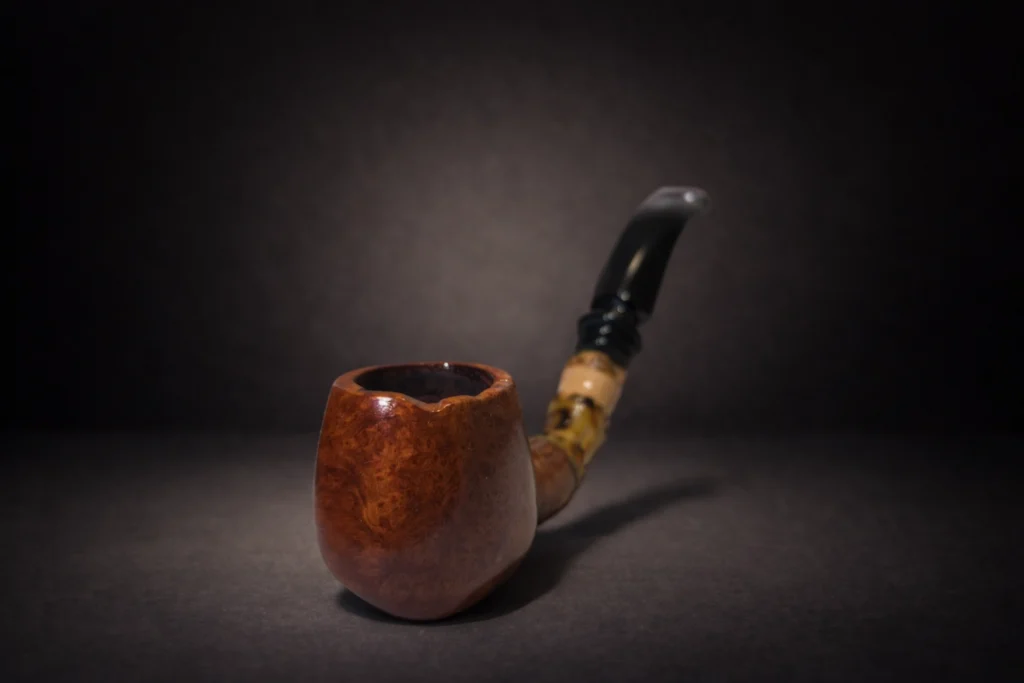
Chamber Rules and Tobacco Cuts: When They Help, and When They Only Confuse
In pipe smoking, you quickly learn a few “rules” that sound highly convincing: a narrow, deeper chamber for flake, a wider one for ribbon, one pipe for one kind of tobacco, one shape for one smoking style. These ideas have logic behind them and are often useful as a starting map, but the problem begins when people treat them like natural law rather than informed guidance. This article does not tear down all chamber wisdom. It puts it in its proper place. The goal is to show where these rules genuinely help, where exceptions begin, and how not to fall into the trap of taking theory about pipe shape more seriously than your own experience with a specific chamber, a specific blend, and your own smoking cadence.
Why chamber rules sound wiser than they sometimes work in practice
One of the attractive things about pipe smoking is that there seems to be a map for everything. For every tobacco cut, every pipe shape, every habit of smoking, someone already has a theory, a recommendation, or a short formula that promises to make the path easier. That is useful, especially to a beginner. No one wants to discover every step from nothing if experience already exists.
So a smoker quickly learns a few often repeated rules. flake likes a narrower, deeper chamber. Ribbon wants more width. One Pipe shape works better for Virginias, another for English blends. A wider chamber opens a blend, a narrower one focuses it. All of that sounds persuasive because there really is logic behind it.
The problem begins when that logic turns into dogma. At that point, the smoker stops using rules as a starting map and starts carrying them like a burden. Instead of noticing what the pipe is actually doing, the smoker begins checking whether personal experience is violating a theory read somewhere else.
Where chamber rules come from in the first place
These rules did not fall from the sky. They grew from repeated observation. Tobacco does not behave the same way in a narrow, deep chamber as it does in a wide, shallow one. Chamber geometry changes how the ember moves, how much surface is active at once, and how the smoker perceives the development of flavor through the bowl.
In that sense, advice that a certain cut or a certain style of blend often prefers a certain chamber type is not nonsense at all. It can be very useful. For a beginner, it can shorten the path to the first reasonable successes. If the smoker has no orientation at all, at least there is a direction from which to begin testing.
The problem is not that rules exist. The problem is forgetting how they were formed: from recurring tendencies, not from universal laws.
When those rules genuinely help
Rules about chamber shape are especially useful when entering a new type of tobacco or buying a pipe without much experience behind you. What you need in that moment is not absolute truth but a reasonable starting assumption. If you know, for example, that you mostly smoke flake and similar cuts, it is perfectly sensible to consider chambers in which those forms often behave more calmly and neatly for many smokers.
The same applies to ribbon or to blends that seem to reward more breadth and a different style of ember development. In that sense, chamber rules can help you avoid buying completely blind. They are not a guarantee, but they do filter out pure randomness.
In other words, rules are most useful as a first tool for narrowing the field, not as a final sentence on what may or may not be smoked in a given pipe.
Where exceptions begin
Exceptions begin almost immediately, the moment theory touches an actual hand. A pipe is not only a chamber. It is also drilling, overall engineering, how it sits in the mouth, how you smoke, how the tobacco was prepared that day, and how quickly or slowly the bowl is carried. All of those factors can overpower an elegant theory about diameter and depth.
That is why two smokers can honestly reach different conclusions from the same blend in pipes that belong to the same nominal chamber category. One will find that a narrow chamber gives focus and order. Another will feel only that the session became too linear or too technically demanding. One smoker will feel a wider chamber opens complexity. Another will feel that it only diffused the flavor that had been better gathered elsewhere.
This does not mean everything is subjective to the point of uselessness. It means only that rules meet a real person very quickly, and a real person is never just a chart.
The most common trap: buying a theory instead of a pipe
Once a smoker starts reading seriously about chambers, it is easy to fall into a very modern kind of trap: no longer buying a pipe, but buying a theory of a pipe. The smoker begins to believe that a certain exact diameter, a certain depth, and a certain shape are required to smoke a given blend “correctly.”
That is a dangerous path, not because theory is worthless, but because it can become louder than experience. A person can end up with a pipe perfectly matched to internet wisdom and badly matched to the hand, habit, and actual way of smoking. At that point, the rule has not helped. It has distorted the choice.
A good pipe is not merely a geometric statement. It is also a relationship. If the rhythm, ergonomics, and overall feel do not suit you, theoretical chamber correctness will not save the experience.
When to trust theory, and when to trust the test
The healthiest relationship to chamber wisdom is a two-step one. First, trust it enough to let it narrow the field. Then stop trusting it blindly and test it. That is the difference between guidance and dogma. Guidance says, “this is probably a good place to begin.” Dogma says, “if your experience disagrees, your experience must be wrong.”
In pipe smoking, the first approach is almost always better. If theory suggests that a certain chamber should suit your favorite cut, excellent—start there. But if, after a fair number of bowls, you find that the blend lives better for you in another pipe, there is no wisdom in declaring your own palate mistaken simply because it fails to match a neat sentence.
How to test without confusion
The best test is not chaotic jumping from pipe to pipe with no order. It is much more useful to smoke the same blend in two different chambers across several bowls, while keeping the conditions as similar as possible. Similar Moisture, similar preparation, similar cadence. That is when you begin to feel what the chamber is doing, instead of attributing everything to mood or a poor pack.
It helps to watch a few concrete things: how the pipe takes the flame, how the flavor develops in the middle of the bowl, whether the draw remains orderly, whether the pipe overheats, and whether the overall experience feels more focused or more diffuse. Once you have seen that across several bowls, chamber rules fall into their proper place. They are no longer sacred truth, but neither are they useless.
Why beginners still need rules
All of this may sound as though the best solution is to ignore advice and simply smoke anything in anything. That would be the wrong lesson. Beginners do need rules because rules provide the first frame. Without that frame, everything can become a blur of trial and error with very little meaning attached to it.
The real problem is not the existence of rules, but the way you carry them. If you carry them lightly, they help. If you carry them as identity or burden, they begin to suffocate the very experience they were supposed to enrich.
What is worth remembering in the end
Rules about chambers and tobacco cuts are not nonsense. They come from real patterns and often save time, money, and frustration. But they are not scripture either. They show tendencies. They do not issue commands.
So the wisest move is to take from them what they genuinely offer: a starting direction, a language for noticing differences, and a framework for more sensible buying. After that, experience has to step in. Not someone else’s experience. Yours.
Because a pipe does not smoke according to theory alone. It smokes according to the meeting of theory, object, and person. And that meeting is always a little more alive than any rule trying to imprison it in a single sentence.