pipe maintenance: The Complete Guide from Daily Cleaning to a Deep Reset
Everything you need to know about pipe maintenance in one place: what to do after each session, how to tell moisture from a real problem, when to check the stem, Cake, and filters, and when a pipe truly needs a deeper reset.
Why pipe maintenance Is Neither a Small Detail nor a Ritual
A pipe works best when it is treated neither as a disposable object nor as a sacred relic that must never be touched. In the first case, small things are neglected until they become larger problems. In the second, the owner begins doing too much, too often, and in places where intervention is not needed at all. Maintenance is therefore not a chain of dramatic procedures. It is a sense of rhythm: what to do immediately, what to watch from time to time, and when to admit that the pipe needs something more than routine care.
This matters because many pipe problems do not begin dramatically. They arrive as a small shift in feeling: a little more moisture, a heavier taste, a smell that lingers, a stem that no longer feels quite as clean as it should, Cake that was once calm but now wants more space. Once you learn to read those signs, maintenance stays simple. If you ignore them, or react too aggressively every time, the pipe quickly starts seeming more demanding than it really is.
How to Read This Guide
This pillar is designed as a central article on pipe maintenance. It does not try to exhaust every subtopic to the last detail. Instead, it gives the reader the whole picture first: what daily routine means, how to distinguish moisture from a real problem, when to pay attention to the stem, Cake, and filters, and where the subject of a deeper reset begins.
It works best as a map of the subject. If you want the overview, you will find it here. If you already know where your specific issue lies, this guide should point you in the right direction: daily cleaning, drying, stem care, filters, cake, storage, or deeper reset work.
What a Pipe Needs After Every Smoke
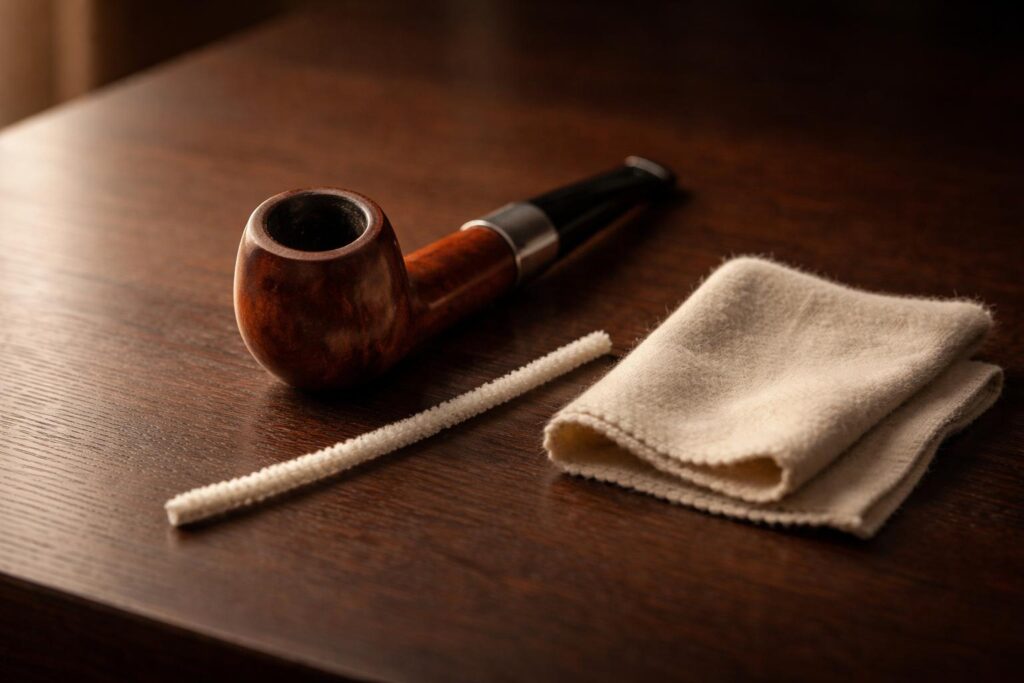
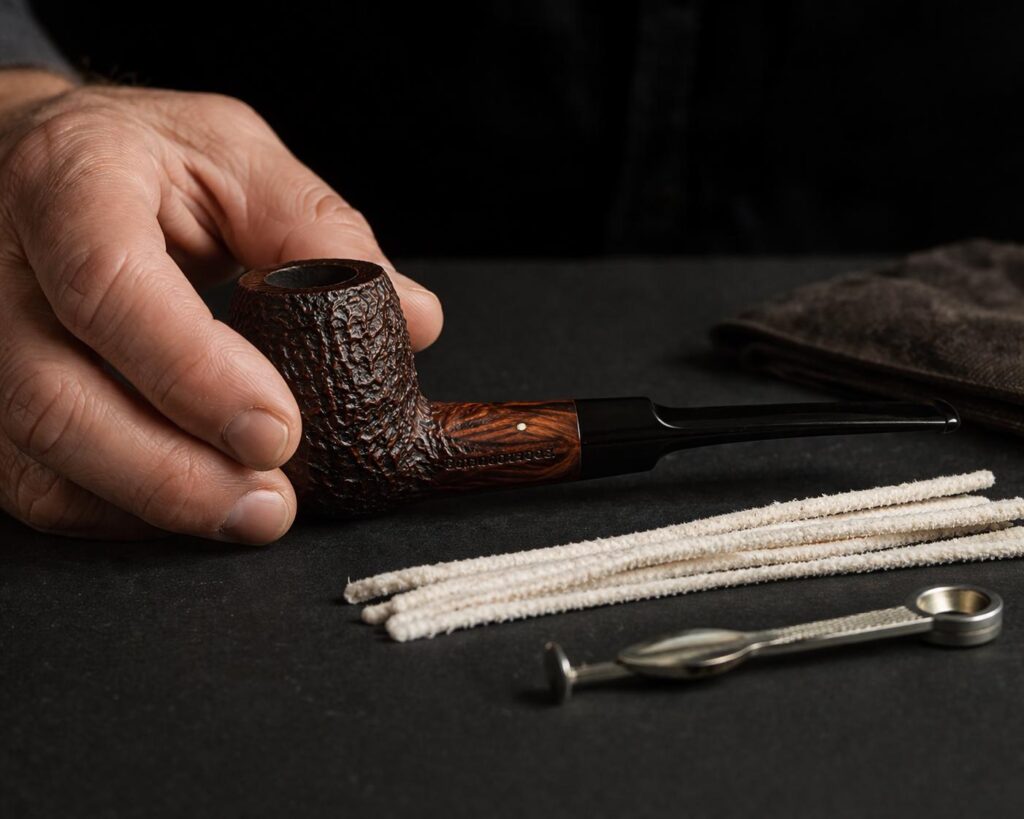
After smoking, a pipe does not need a full service. It needs a short, calm routine. Usually that means gently emptying the bowl, running a cleaner through the airway and stem, wiping the stem, and letting the pipe breathe. This deals with what is still fresh: moisture, light residue, and the first trace of what might otherwise settle deeper. If this is done regularly, much of what later becomes “a problem” never has the chance to become one.
The most common mistake after smoking is not laziness but excess. People take the pipe apart while it is still Warm, scrub the chamber as though they are trying to erase every sign of use, and shut the pipe away too quickly because they want instant tidiness. Good routine care is shorter and wiser than that. The goal is not sterility. It is an orderly end to the session.
When to Clean, and When to Simply Let the Pipe Dry
One of the most useful distinctions in pipe care is the distinction between cleaning and drying. Not every wet or heavy session calls for serious intervention. Sometimes the tobacco was simply moister, the pace quicker, the weather less favorable, or the pipe returned to service too soon. In such Cases, running a cleaner through, giving the pipe air and time, and observing the next session may be all that is needed.
This matters because moisture often imitates a bigger problem than it really is. A pipe may gurgle briefly, the taste may turn dull, and the system may feel heavier, without yet being deeply dirty. A thoughtful pipe owner does not reach for the heavier solution just because the gentler one seems less impressive. First rule out the simpler cause. Only then conclude that a reset is necessary.
A Weekly and Monthly Rhythm That Makes Sense
There is no calendar that suits every pipe equally. It matters whether you smoke one pipe daily or rotate several, whether you use filters, whether your tobaccos tend to be moist, and how heavily a favorite pipe is used. Yet there is still a practical logic that almost always holds: do the basics after each smoke, watch the pipe occasionally, and step back from time to time to see the larger pattern.
That larger pattern includes simple questions. How does the mortise smell? Are cleaners coming out darker and stickier than before? Is moisture returning more often? Is the stem still in good order? Is the Cake still thin and calm, or beginning to demand room? The point is not to turn pipe care into a chart or a laboratory. The point is to notice problems while they are still small and before they become habit.
The Stem and Cake: Two Small Areas That Reveal the Pipe’s Condition Quickly
The stem often shows more than the owner wants to admit. Bite Marks, buildup, oxidation on vulcanite, and the general feel of the mouthpiece all reveal how consistently the pipe is being cared for. That is why the stem is not merely decorative. It is part of the pipe’s function and one of the clearest indicators of whether maintenance is calm and regular or delayed and improvised.
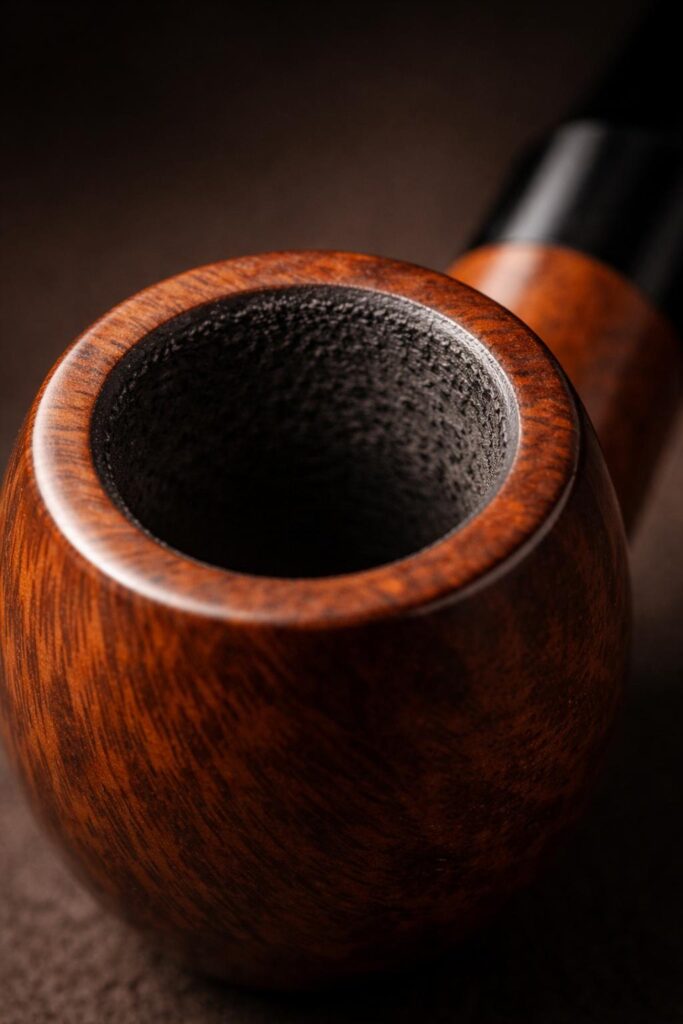
Cake is just as easy to mythologize. Some fear it, others celebrate it as proof of maturity. The truth is simpler. A thin and even cake can be entirely normal in a briar pipe. Trouble begins when the layer becomes too thick, uneven, rough, or cracked. At that point it is no longer a quiet trace of use. It is something beginning to dominate the chamber.
Material matters here as well. What is reasonable in briar may not be reasonable in meerschaum. That is why cake should neither be worshipped nor stripped mechanically according to one magic number. It should be judged in context: how much room it takes, how even it is, and whether it behaves like a stable layer or a problem in the making.
Filters, Adapters, and Systems That Hide Moisture Where You Do Not See It First
A filter pipe does not necessarily demand more work, but it does demand a different kind of attention. In such systems, moisture does not collect only where you expect it in a standard pipe. It also gathers around the filter chamber, tenon, adapter, and widened transitions in the smoke path. A filter is therefore not a detail that can be forgotten while sorting itself out.
Disposable filters have a real useful life, not just a theoretical one. Once saturated, they stop helping the system and begin burdening it. Adapters and metal inserts need more cleaning than replacement, but they still remain parts of the system that deserve attention. If a filter pipe is maintained as though none of these additional zones existed, the true source of the problem is easily missed.
When the Problem Is Moisture, and When It Is the Blend, Technique, or the Pipe
One reason maintenance sometimes feels exhausting is that different causes often share the same symptoms. Wet smoke, gurgling, heavy flavor, and a pipe that seems to draw poorly may all come from retained moisture, from tobacco that was not ready, from smoking pace, or from the pipe itself. That is why diagnosis matters more than quick conclusions.
The wisest order of thinking is usually this: first check whether the issue appears with all tobaccos or only some. Then ask whether the pipe had enough rest and drying time. After that, consider whether technique is playing a larger role than you wish to admit. Only then does it make sense to suspect the pipe’s construction or deeper internal fouling. Skip that order, and you may end up treating the wrong problem very confidently.
When a Pipe Truly Needs a Deep Reset
Deep cleaning is not a heroic act that proves devotion. It is a response to buildup that has gone beyond everyday routine. If a pipe smells stale even after rest, if moisture keeps returning no matter what, if cleaners come out dark and sticky again and again, or if the taste turns stubbornly sour and old, then a deeper reset begins to make sense. But as long as the problem responds to ordinary care and rest, there is no reason to turn every second smoke into a repair session.
It is equally important to understand that deep cleaning does not automatically mean aggression. Not every dark-looking pipe needs strong methods. Not every smell calls for the harshest possible response. A good reset begins with an accurate reading of the pipe’s condition, not with the desire to solve everything in one forceful gesture.
With an estate pipe, maintenance gains another layer. You are no longer dealing only with your own traces of use. You are deciding what is dirt, what is functional trouble, and what is patina that should not be wiped away simply because it looks old. An estate pipe therefore does not ask to become new at once. It asks first for hygiene and function, and only after that for decisions about appearance.
Storage: Half of Maintenance Happens Between Sessions
A pipe does not age only while it is being smoked. It also ages while it rests. That is why racks, shelves, Cases, air, heat, and humidity belong to the same conversation as cleaners and chamber walls. A pipe that is put away too early, shut up while still damp, or kept in a place that is too hot, too sunny, or too stale may later show symptoms that get blamed on tobacco, technique, or construction, even though the real problem was storage.
Good storage is not complicated. A pipe needs a reasonably calm and dry place, some air after smoking, and protection when traveling. It does not need a laboratory. It only needs not to be treated as an object that can be dropped anywhere without consequence. This matters especially in larger rotations, where pipes that are smoked less often can still slowly develop bad habits if ignored for too long.

The Most Common Mistakes That Make Maintenance Harder Than It Needs to Be
The first is taking a pipe apart while it is still Warm. The second is skipping routine care and then trying to make up for it with one dramatic cleaning session. The third is confusing moisture with dirt. The fourth is assuming every dark mark means failure or neglect. The fifth is the opposite: refusing to notice anything until the pipe is already asking loudly for help.
There are also specific versions of the same error: keeping a filter too long, ignoring the stem until it looks tired, letting Cake grow without any control, putting a damp pipe into a case, or blaming a blend before fairly checking drying time and rest. These are all small mistakes. That is exactly why they are dangerous: none of them looks dramatic until repeated often enough.
pipe maintenance Is Ultimately the Craft of Proportion
At first, maintenance can seem like one more discipline to master before a person can even enjoy pipe smoking calmly. With time, however, it becomes clear that a pipe demands less work than it first appeared to. What it asks for is consistency. A few simple steps after smoking. Some attention now and then. Caution with heat, moisture, and bad habits. And the willingness not to reach immediately for the harsher solution simply because it feels more serious.
A good pipe does not ask for constant intervention. It asks to be understood. Once that understanding is in place, maintenance stops being a list of rules and becomes an extension of the same craft that begins with packing, continues with smoking, and ends with how the pipe is left to rest until next time.