Beginner’s Guide: How to Smoke a Pipe Properly
A guide to packing, lighting, cadence, and common mistakes. A main beginner’s guide that brings the whole pipe-smoking process together in one place.
Why this guide exists
Pipe smoking does not require a secret technique. It requires a good feel for a few basic things that work together: tobacco, packing, flame, rhythm, and the ability to read what is happening in the bowl. Beginners often search for a single formula that will solve everything at once, but pipes rarely work that way. A good session comes not from one perfect move, but from a series of calm, good-enough decisions.
This article is designed as the main guide to the whole subject. It does not try to replace detailed articles about packing, relights, tongue bite, burn line, tobacco Moisture, or mid-bowl problems. Its job is to give the full picture and show how all those subjects hold together.
The most important opening thought is simple: a pipe should never be smoked by force. Most beginner mistakes happen when a smoker does too much at the wrong moment. Too much pressure, too much flame, too much puffing to “save” the bowl, or too much insistence on a perfect finish. A good pipe asks for proportion more than power.
Preparation begins before the flame
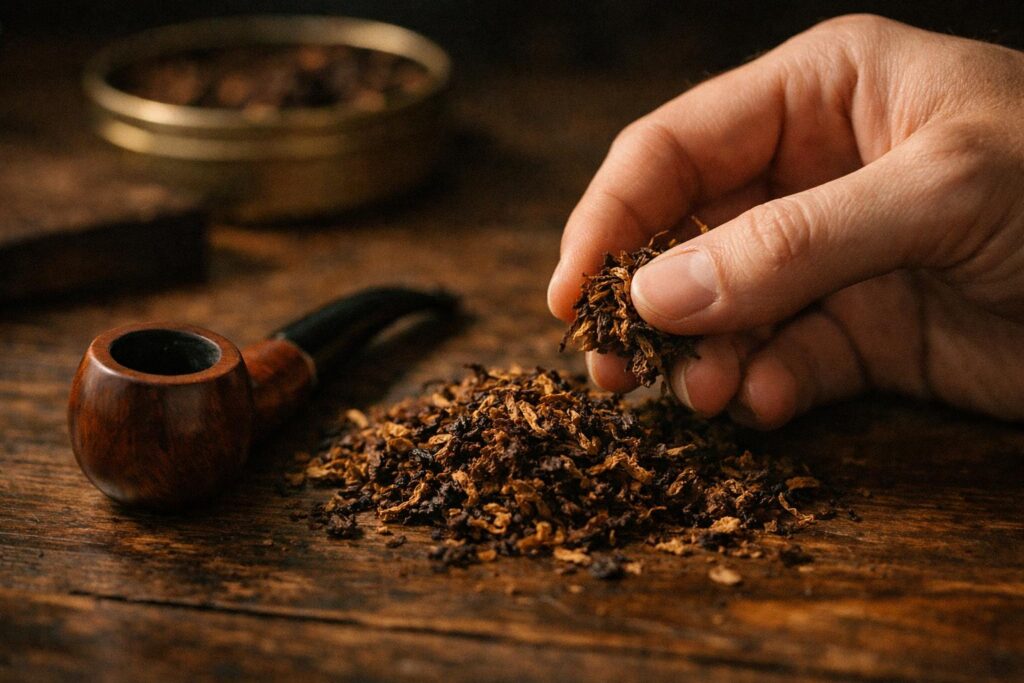
Many problems that beginners later blame on packing or smoking technique actually begin before the pipe is ever lit. If the tobacco is too dry, the bowl can feel empty, fast, and nervous. If it is too wet, it resists fire, asks for more relights, and creates Moisture more easily inside the chamber.
That is why the first serious step is learning to recognize when tobacco is ready for the pipe. There is no need to turn that into a ritual or a laboratory exercise, but you do need to build a feel for it. Tobacco should be lively enough to take flame and calm enough not to flare like paper or sit in the bowl as a heavy, stubborn mass.
It also matters that different cuts do not want the same preparation. Ribbon, ready rubbed, flake, and cube cut do not behave in identical ways. Smoking a pipe properly always begins with a simple question: what exactly did I put into the bowl, and in what condition?
Packing: the balance between air and structure
Beginners often search for one famous packing method that will solve everything. In reality, it matters more to understand what packing is actually meant to do. It must allow two things at the same time: enough air for the ember to breathe and enough structure for the ember to move downward through the bowl without falling apart.
When the pack is too tight, the pipe feels closed. The draw is heavy, lighting becomes stubborn, and the ember seems short of oxygen. When the pack is too loose, air moves easily, but the ember has poor contact with the tobacco below it. The surface catches, then fades. It comes back, then loses continuity again.
A good pack should not be imagined as a perfect shape, but as a sensible relationship. The unlit draw should feel open but not empty. The top of the bowl should be orderly enough to take flame, but not so compressed that it suffocates the chamber before the session truly begins.
Lighting as the foundation of the rest of the bowl
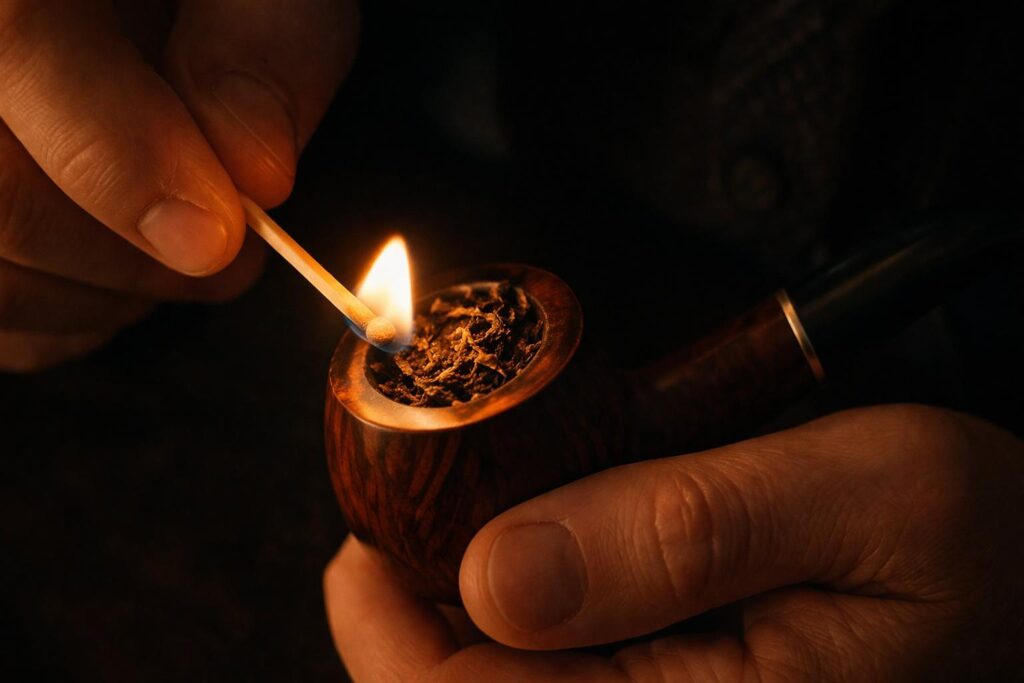
Many later problems begin with poor lighting. If the top layer never catches evenly, the whole smoke often lacks a proper foundation. That is why the key is not making everything flare at once, but giving the surface a fair and steady beginning.
Beginners often fall into one of two extremes here. Either they light too timidly, so the surface never truly catches, or they light too aggressively, with too much air and too much urgency, as if a perfect smoke must be forced from the very first second. Neither helps. A good start is controlled and free of drama.
Once the top layer is properly established, the rest of the session becomes much easier to manage. If it never settles properly, the relights that come later are often not a separate problem at all, but simply a delayed result of a weak beginning.
Cadence: calm, but alive
After packing and lighting comes the part that most clearly separates a calm pipe from a nervous one: cadence, the rhythm of puffing. A great deal of the whole session happens here. It is not enough to know how to light the bowl. You also need to keep it alive without pushing it beyond its limits.
Too-fast cadence usually does not look dramatic. It appears as a chain of small, overly frequent interventions. You puff a little more than necessary, a little more often than needed, and trust the ember a little less than you should. The result shows itself as a warmer bowl, thinner flavor, and a session that feels more and more like damage control.
Too-slow cadence causes a different problem. The beginner wants to smoke “slowly” and leaves the bowl without enough life. The ember never finds continuity, the pipe goes quiet, and relights begin to pile up. That is why it is important to distinguish between calm rhythm and dead rhythm. Calm rhythm keeps the bowl together without anxiety. Dead rhythm is only silence between extinctions.
Tamping and relights without anxiety
There is nothing shameful in gently tamping or relighting when a pipe needs it. The problem is not the intervention itself, but the way beginners often do it too harshly or too late. A tamper is not an instrument of force. Its job is not to crush the chamber into obedience, but to help the surface remain orderly and connected.
The same is true of relights. A good smoke does not have to mean a smoke without any relights at all. What matters far more is how the pipe behaves after the relight than the simple fact that it went out. If a calm relight restores order, that is not failure but correction. If you must relight every few minutes while everything becomes hotter and rougher, then the relight is no longer a small aid, but a symptom.
The goal is not to eliminate every intervention, but to reduce them to a reasonable level. A pipe should be managed neither stubbornly nor nervously, but calmly.
How to read the pipe while you smoke
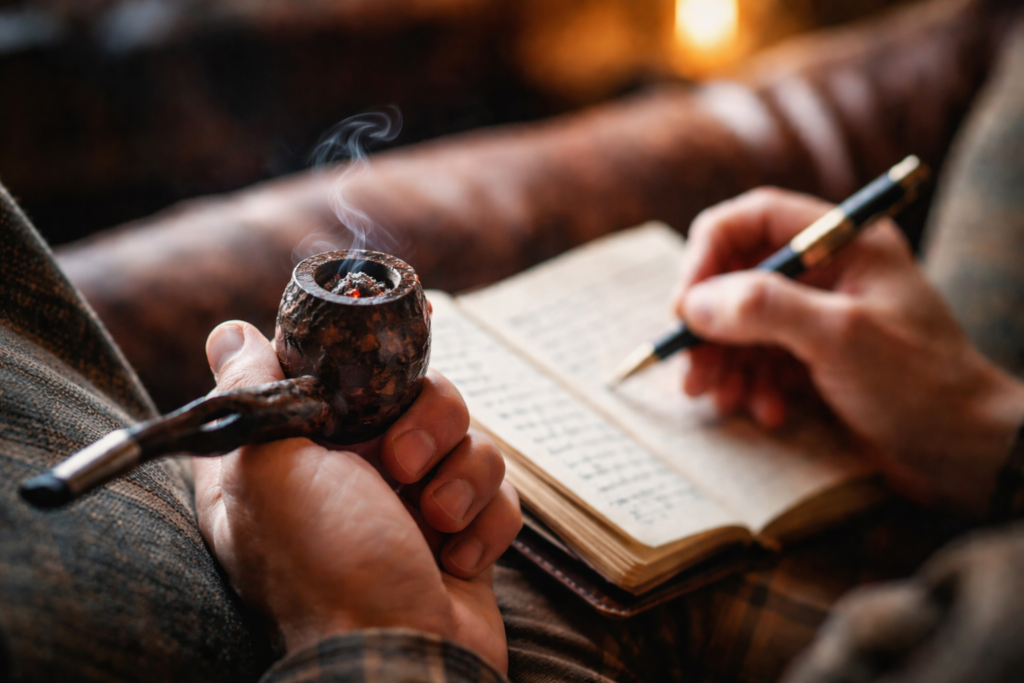
A good pipe speaks, just not in words. It speaks through resistance, flavor, heat, burn line, Moisture, and the frequency with which it asks for help. The smoker who learns to read that depends far less on universal rules and ready-made formulas.
If the bowl gets warmer while the flavor grows thinner, something in the cadence is likely becoming too aggressive. If the draw becomes messy and wetter, the issue may lie in moisture or in the way the session is moving toward the middle and bottom. If the top third behaves well while the middle and bottom struggle, that often tells you more about packing and accumulated consequences than about the beginning itself.
In other words, smoking a pipe properly is not about memorizing fixed answers. It is about learning better questions.
The most common mistakes that ruin a bowl
The first major mistake is believing that everything can be solved by force. The second is believing that everything must be solved all at once. The third is confusing symptoms with causes. A beginner feels the pipe going out and immediately starts puffing harder. He feels heat and panics so much that he kills the rhythm entirely. He notices Moisture and blames the pack, even though the tobacco may have been poorly prepared long before the bowl was filled.
Another very common mistake is chasing perfection in every phase. A perfect bottom, a perfect one-light bowl, a perfectly cool chamber, a smoke without relights. Those expectations usually do more harm than good because they turn the smoker into a controller instead of an observer.
One more important mistake is ignoring the difference between the beginning, the middle, and the bottom of the bowl. It is not the same thing when a pipe starts badly and when it falls apart only halfway through. It is not the same thing when the problem is at the top of the chamber and when only the bottom begins resisting. The smoker who places all bad sessions into the same drawer learns very slowly.
When heat and your tongue begin to warn you
One of the most unpleasant beginner problems is tongue bite, but it rarely comes from nowhere. Most often it appears where too much heat, too much haste, too little restraint, and sometimes tobacco that demanded more care all meet in the same place. That is why it should not be treated as an isolated mystery, but as a warning that the whole session has moved in an overly aggressive direction.
The same applies to bowl temperature. Not every warm pipe is overheated, but not all warmth is harmless either. You need to distinguish between a lively, normally warm smoke and one in which heat begins to dominate the experience. Once flavor declines, the bowl becomes more sensitive, and the rhythm grows tense, it is no longer just a warmer pipe. It is a sign that the way of smoking itself needs correction.
What it means to smoke a pipe properly as a beginner
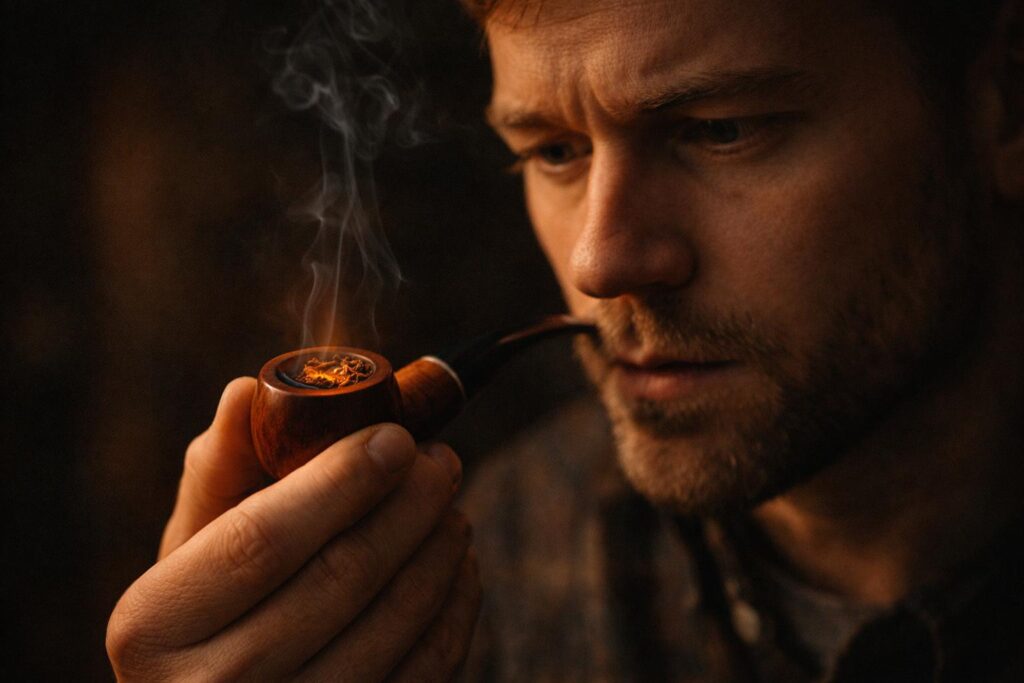
For a beginner, smoking a pipe properly does not mean looking experienced. It does not mean knowing every term, every cut, and every trick. It means learning a few basic things well enough that a session becomes readable: preparing tobacco sensibly, packing the bowl so the ember has both air and structure, lighting without drama, and keeping a steady pace without forcing it.
It also means learning to recognize when the problem comes from packing, when it comes from Moisture, when it comes from cadence, and when it comes simply from expecting too much. That is already a lot, and it is enough to turn the pipe from an unpredictable riddle into a calm and dependable ritual.
You do not need to master every nuance at once in order to smoke well. You only need to stop demanding perfection from every bowl and begin asking it for understanding.
This guide is a beginning, not the end of the subject
No single article, not even one like this, can replace every individual subject that pipe smoking opens up later. The difference between tobacco that is too dry and too wet, the many Cuts, packing methods, relights, burn line, tongue bite, temperature control, mid-bowl behavior, or the bottom of the bowl — each of these is large enough to deserve its own detailed article.
That is exactly why a main guide makes sense. It is not here to close the topic, but to organize it. Once the reader sees how all those things hold together, detailed articles no longer feel like disconnected tips, but like parts of the same whole.
That is why smoking a pipe properly does not mean chasing one perfect technique. It means holding the whole together.