How to Choose Your First Pipe
A complete beginner’s guide to material, shape, bowl size, filter, weight, and smoking routine. Here you will learn how to choose a first pipe that truly suits you, without unnecessary mistakes or confusion.
Your first pipe does not need to be perfect, only fair
A first pipe easily becomes something larger in a beginner’s mind than it really needs to be. That is understandable. You are not buying only an object, but entering a slower, more ritualized, and often more personal world. Because of that, many beginners feel as though the first pipe must somehow be “the right one,” as if the opening purchase should already define their whole future relationship with pipe smoking.
But the healthiest beginning is usually much less dramatic than that. A first pipe does not need to be perfect. It does not need to be the most beautiful, the rarest, or the most ceremonial. Above all, it needs to be good enough to teach you something. That matters much more than the feeling that you have already bought a pipe worthy of years of dreaming.
A good first pipe should be readable. That means it does not complicate things more than necessary, does not require special circumstances to feel pleasant, and does not turn every small beginner mistake into major frustration. A beginner needs a pipe that forgives something, reveals something, and does not demand more knowledge than he realistically has.
This does not mean a first pipe must be dull or without character. It only means its main role is not to impress, but to teach. Once you understand that, it becomes much easier to separate real beginner value from mere impression.
What to decide before you buy
Beginners often start by looking for the universally best first pipe. But that pipe probably does not exist. What does exist is a better or worse first choice for a particular person, a particular routine, and a particular set of expectations.
It matters whether you mostly smoke at home, whether you want shorter or longer sessions, whether practicality matters to you, whether you are drawn to bent or straight pipes, whether you want a filter, and whether you are buying online or in person. That is why the first serious step is not only to look at the pipe, but to look at yourself.
How do you realistically imagine smoking? How often? How long? Where? Do you want a calmer beginning or a more distinctive experience? Once you answer those questions even approximately, the first pipe stops being an abstract desire and becomes a concrete decision.
Why most beginners start with briar
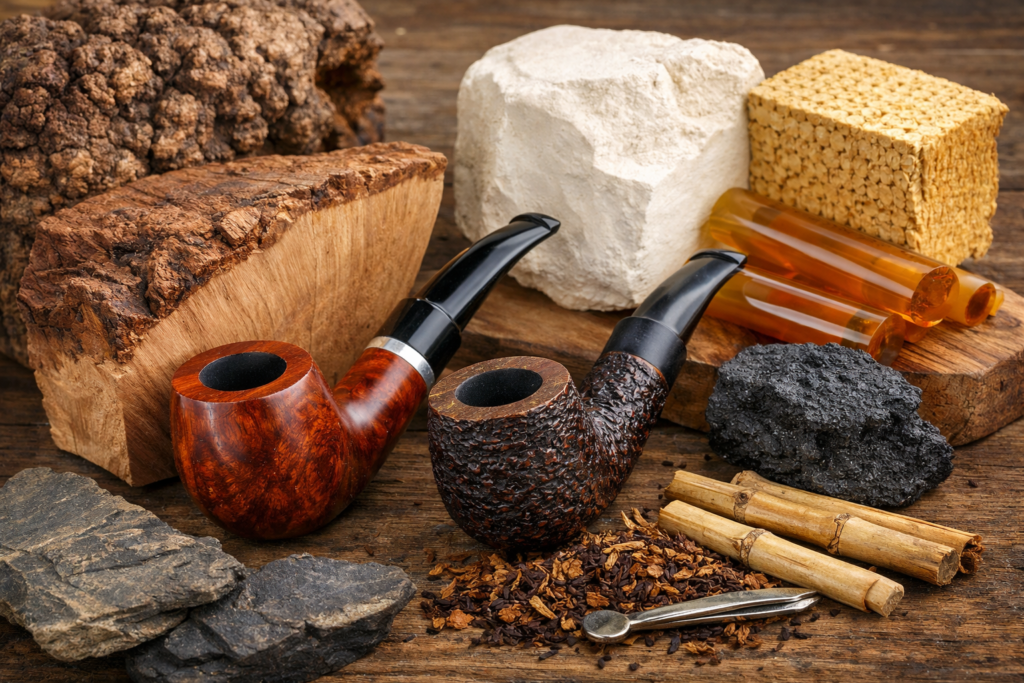
For the vast majority of beginners, briar remains the healthiest first choice. That is not because other materials lack value, but because briar usually offers the best balance of durability, stability, longevity, and the general sense that the pipe does not require special treatment from day one.
That matters to a beginner much more than it first appears. A good first pipe does not need to be exotic in order to be good. It needs to be reliable enough to teach through use without creating the feeling that the material itself keeps introducing new complications.
Other materials can be excellent and worth exploring, but they often ask for more understanding, more specific expectations, or simply more experience before their qualities can be appreciated properly. That is why briar is such a strong beginner’s choice: not because it is the only worthy option, but because it is the most balanced one.
First-pipe shape: choose by routine, not only by impression
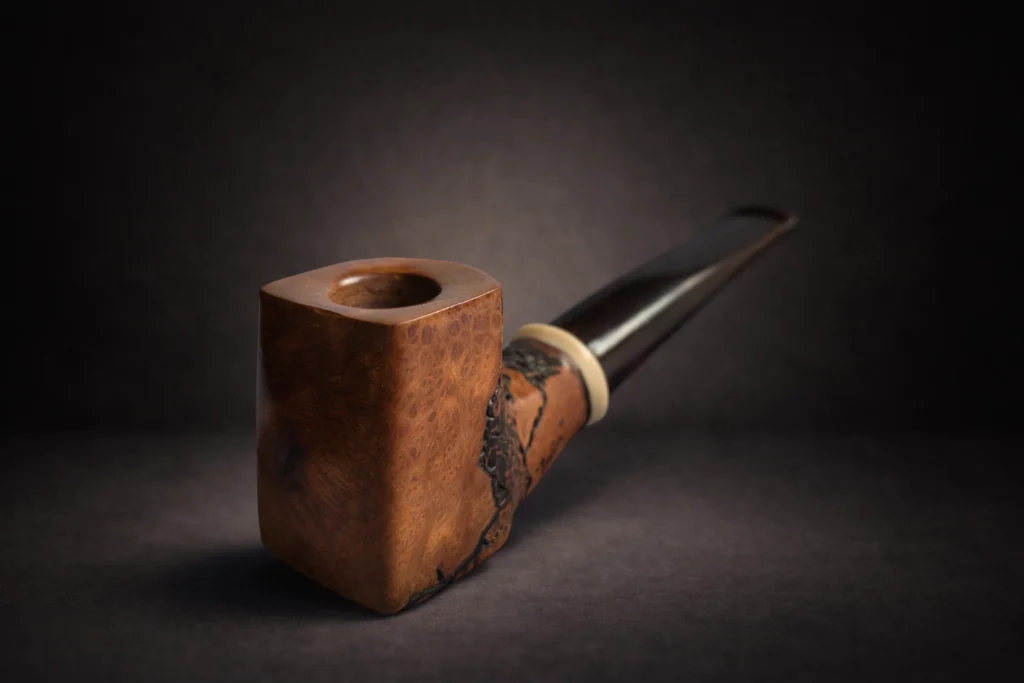
Shape is almost always the first thing that catches a beginner’s eye. That is normal. Billiard, bent, pot, dublin, bulldog, apple, nosewarmer, churchwarden — none of these look the same, and none of them carry the same atmosphere. The problem begins only when shape is chosen purely as identity and not also as part of real use.
It helps much more to ask how a given shape sits in the hand, how it fits your routine, and whether it asks for a simpler or more specific relationship. Shape is not only aesthetics. It changes the feeling of the pipe, its presence, and sometimes even the way you experience a session.
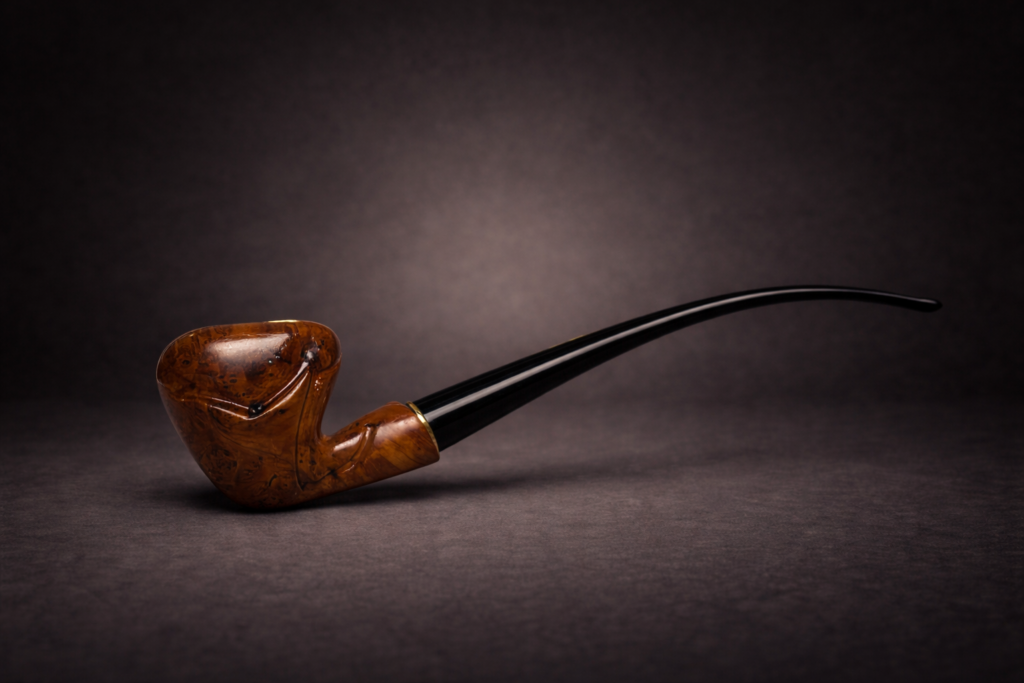
A straight pipe often feels like the clearest and most direct beginning. A bent pipe feels immediately softer or more natural to some people, while to others it remains mainly an object of attraction. A churchwarden, on the other hand, easily wins people over through its sense of distinctiveness, though it often asks for a calmer context and is not always the most universal first pipe.
None of these directions is automatically right or wrong. The point is simply that each carries a different expectation. If a beginner chooses bent or churchwarden, it helps if that choice is not made only because the form feels more romantic, but because it actually fits the life and routine the smoker expects to live.
Three things beginners most often underestimate
Many beginners look at the outside of a bowl, but do not think enough about what the chamber itself really means. And bowl size very quickly begins affecting how long a session lasts, how much concentration it demands, and how easily beginner mistakes remain small or turn into a long struggle.
A very large chamber may sound serious and attractive, but it often gives beginners more room for disorder, uneven rhythm, and fatigue. A very small chamber may be tidy and practical, but to some people it can feel too brief or too narrow for a fair introduction. In practice, the healthiest first choice is very often a middle, balanced compromise.
A filter is not a question of correctness, but of habit and feel. Weight also becomes real very quickly: it matters whether you mostly hold the pipe in the hand or whether it matters to you that it can occasionally rest comfortably between the teeth. Weight and balance together often decide more than a beginner expects.

How routine changes the right first choice
It is not the same whether you are choosing a pipe for calm evenings at home or for shorter, more practical moments during the day. If you almost always smoke in peace, you can allow yourself a pipe that better supports a seated and slower experience. If you already know that your pipe will more often live in short breaks, terrace moments, or a changing daily rhythm, practicality matters more than the romance of a format.
This is one of the most important beginner truths. Your first pipe should work with your real day, not with an idealized image of smoking. When that is ignored, it becomes very easy to buy a pipe for the life you imagine rather than the life you actually live.
That is why it is not enough to ask only what you like visually. It is more useful to ask when you will most often light that pipe, how long your sessions usually last, and whether you need a pipe that feels calm and practical or one that mainly creates atmosphere. A good first pipe very often begins with that honesty toward your own routine.
How to buy the first pipe without unnecessary wandering
Buying your first pipe in person gives one major advantage: you can feel the proportions, weight, balance, and overall impression in the hand. That is extremely valuable, especially if you do not yet know what suits you. On the other hand, buying online is entirely normal today and can be a very good decision if a beginner knows what to read and what to ask.
Online buying is not a problem by itself. The problem begins when a beginner buys only the lead photograph, the grain, or the first impression of the listing. If you buy online, it matters to look at measurements, multiple angles, the relationship between bowl and shank, the stem, the filter system, the overall character of the pipe, and what the seller is actually saying or not saying.
The same logic applies when choosing between Factory-Made, handmade, and estate pipes. These are not three levels of the same value, but three different paths. A factory-made pipe is often an excellent beginning because it offers clarity and fewer unknowns. A handmade pipe can be a wonderful first choice if you know why you want it. An estate pipe can be very smart, but it asks for more evaluation and more trust in the source.
A good first choice is not the one that sounds most prestigious, but the one that gives the beginner the fairest balance between budget, confidence, and actual use.
The most common first-pipe mistakes
Many beginner mistakes do not happen because a bad pipe was bought, but because the priorities were placed in the wrong order. Grain, exotic material, unusual shape, a very special finish, or a general wow effect easily capture the imagination. There is nothing wrong with any of those things as long as they remain bonuses. The problem begins when they become the main criteria.
A beginner benefits more from a pipe that is readable, balanced, and calm enough to teach something through use. A spectacular pipe can be beautiful, but it is often better as a later choice, once you already know how you smoke and what truly suits you.
It is also completely normal not to know what tobacco you like yet. You do not need to solve the entire map of tobacco styles before buying a first pipe. It is often healthier to choose a fair and balanced pipe first, and only then begin discovering your taste through real sessions.
One pipe can also be more than enough as a beginning. A rotation does not need to come immediately. First learn what one good pipe is already telling you.
What a good first choice often looks like in practice
For a very large number of beginners, a good first choice often looks like this: a briar pipe, a balanced and not overly extreme shape, a medium bowl, a readable relationship between weight and balance, straightforward maintenance, and a general sense that the pipe does not require a special life in order to be enjoyable.
That is not the only possible good formula, but it is a very healthy starting point. Such a pipe does not take too much room away from correction and learning. It does not require the smoker to become an expert immediately. It does not tie him too early to one very narrow style. That is exactly why this kind of pipe so often becomes a better first choice than one that is more interesting, more expensive, more exotic, or more dramatic in impression.
The most common beginner mistakes usually come from the same source: buying by atmosphere instead of routine, looking for identity before experience, trusting wow effect too much, and ignoring chamber size, weight, and balance.
The most important thing a beginner can understand is that the first pipe does not need to carry the whole future. It does not need to become the piece that defines taste, style, and the relationship to pipe smoking forever. It is much healthier for the first pipe to be a fair, balanced, and readable beginning — a piece through which you learn something, not one that obliges you to know everything at once.