Bent or Straight Pipes: It Is Not Just About Looks
In photographs, bent and straight pipes often seem like a purely aesthetic choice, almost as if you were choosing between two versions of the same object. In reality, the difference goes much deeper: into the way the pipe sits between the teeth, how it behaves in the hand, how easy it is to clean, and what kind of relationship it asks for in everyday smoking. That is why choosing between a bent and a straight pipe is not merely a matter of taste in the narrow sense. It is a matter of habit, ergonomics, and actual use. Once a beginner understands that, they stop buying only a “beautiful pipe” and start choosing a tool that better suits their pace, posture, and style of smoking.
Why bent and straight are more than two silhouettes
To a beginner, the difference between a bent pipe and a straight pipe often first appears to be a matter of appearance. One looks softer, warmer, perhaps more elegant. The other seems cleaner, more serious, and more classic. That first impression is not wrong, but it is incomplete. A pipe’s shape does not influence only how it looks on a shelf or in a photograph. It also affects how it behaves in daily smoking.
As soon as you actually hold the pipe and spend more than a few short smokes with it, the differences become physical. The balance changes, the sense of weight changes, the relationship between bowl and mouthpiece changes, the way it sits between the teeth changes, and even the way it asks for your hand changes. That is why bent versus straight is much more than a style question. It is a question of how the object speaks to your body.
What a straight pipe really offers
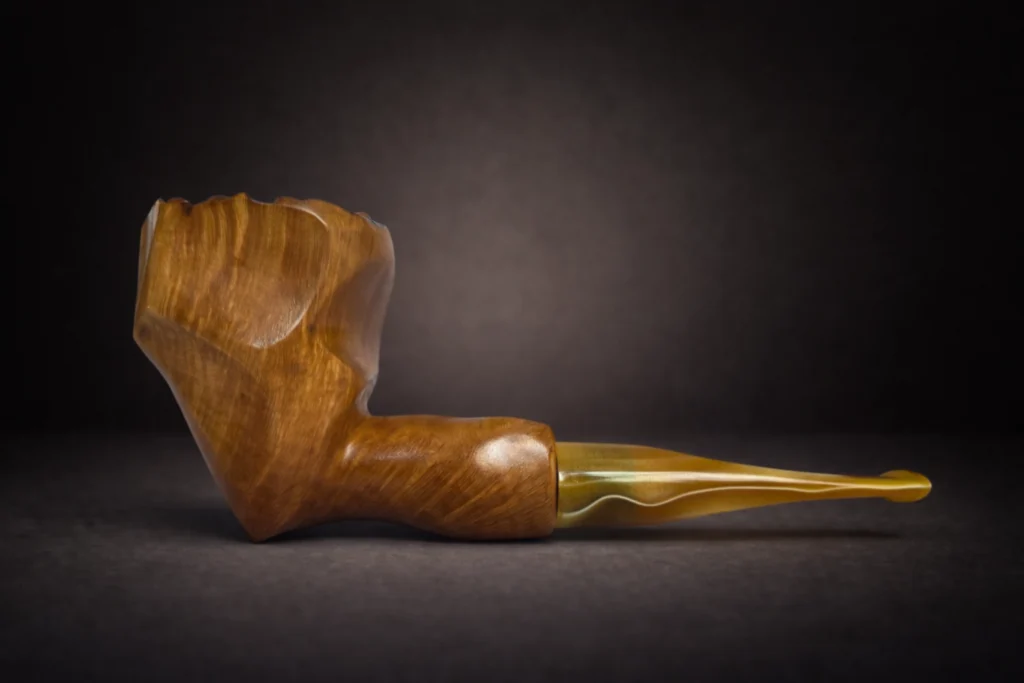
A straight pipe has a more direct line between the bowl, the shank, and the mouthpiece. For many smokers, that form feels intuitive, orderly, and mechanically “clean.” There are fewer visual turns, so everything appears to follow a simple logic from chamber to bit. That is exactly why straight pipes often leave an impression of clarity, discipline, and ease of maintenance.
Many smokers like straight pipes because they feel immediate. In the hand they are predictable, a pipe cleaner often passes through more easily, and the whole construction gives the impression that it works without drama. Of course, no pipe is good simply because it is straight, but the shape often gives beginners confidence because it does not hide its logic.
What a bent pipe changes
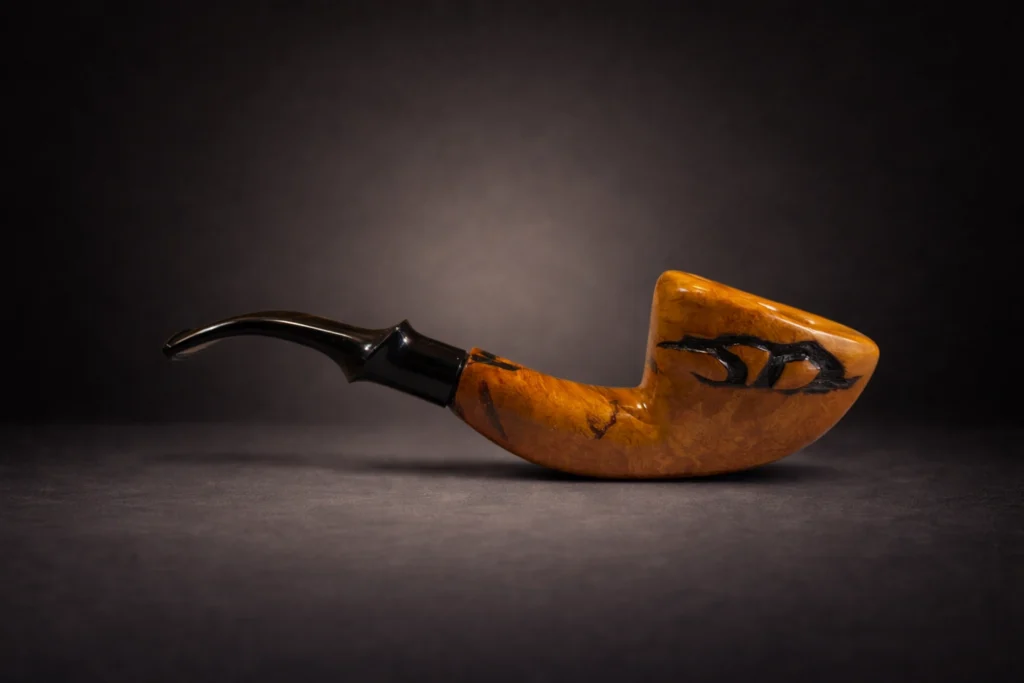
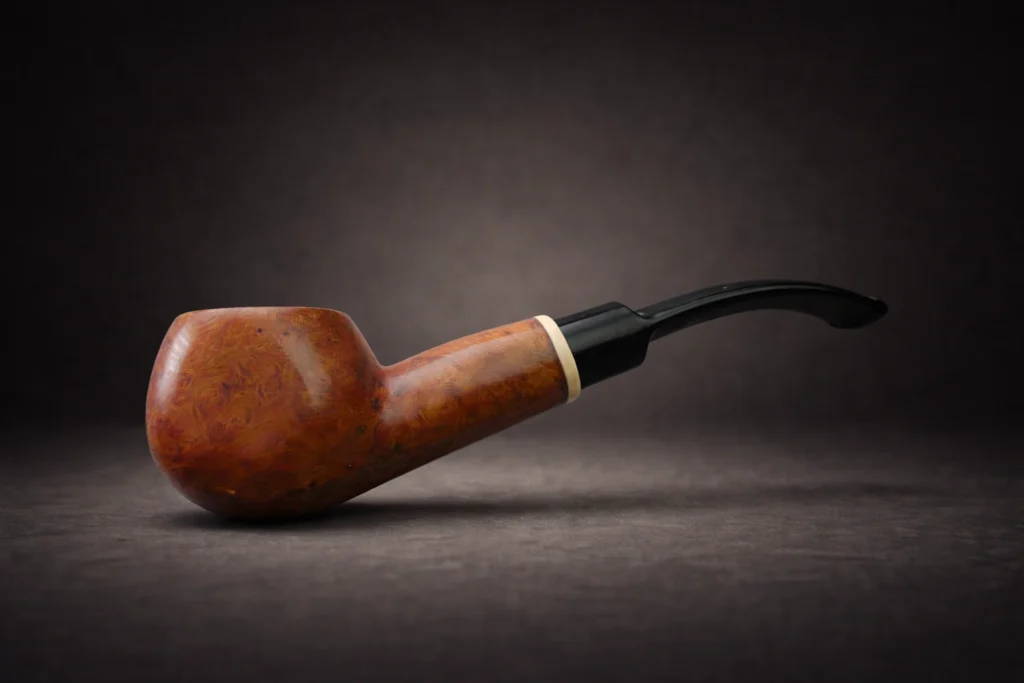
A bent pipe introduces curvature, and that instantly changes balance and the feel in the mouth. The bowl sits lower, the center of gravity often feels more favorable for clenching, and the whole object can seem softer, warmer, and more comfortable for a longer relaxed smoke. Many smokers experience a bent pipe as something that wants to stay with them rather than a tool they occasionally pick up.
That does not mean a bent pipe is automatically more comfortable for everyone. For some, it works immediately. For others, never. But it is true that curvature alters the leverage between the teeth. In some pipes, that alone makes the difference between “I have to keep holding this” and “I can sit with it calmly and let it do its work.”
Balance between the teeth and in the hand
One of the most important differences between bent and straight pipes reveals itself only when you actually smoke them, not when you admire them. A straight pipe often asks for a slightly more active relationship with hand and jaw. It is not necessarily tiring, but its longer visual line can behave like a longer lever. If the bowl is larger or the pipe heavier, some smokers feel that quickly.
A bent pipe, by contrast, often lowers the weight in a way that feels more forgiving in the clench. Not always, and not in every example, but often enough to become a real buying factor. It helps beginners to understand that “comfort” here is not an abstract word. It means whether your jaw remains relaxed after twenty minutes or starts unconsciously searching for a better position.
Cleaning and day-to-day maintenance
This is the part that often sounds boring to beginners until they get home with a pipe that surprises them a little. Straight pipes often win in day-to-day practicality because a more direct airway and a simpler relationship between the parts can make cleaner passage and general maintenance feel easier. That does not mean every straight pipe is easy to clean, but its form often works in its favor.
A bent pipe can be perfectly manageable, but it more often asks you to pay attention to cleaner path, entry angle, and overall engineering. If it is well made, that is not a problem. If it is not, a beginner may feel there is more effort involved than expected. So a bent pipe is not a worse choice, but it does ask for a little more respect for build quality.
Moisture, condensation, and the myth that one shape always smokes drier
There are many claims around bent and straight pipes that sound like firm laws but are often little more than repeated preferences. One of the most common says that straight pipes smoke “drier” while bent pipes collect more moisture. Sometimes there is some truth in that, but it is unwise to turn it into a rule. Much depends on engineering, airway design, your cadence, and how the tobacco was prepared.
A poorly made straight pipe can work worse than a well-made bent pipe without any difficulty. A bent pipe with good engineering can offer a very calm and satisfying smoke. The beginner gains most here by learning to distrust formulas that sound too tidy. Shape matters, but it does not decide alone.
When a straight pipe is often the better choice
A straight pipe often suits the smoker who likes a clear, readable tool, easy cleaning, and a sense of directness. If someone is just entering the hobby, does not yet have a maintenance rhythm, and wants as few extra variables as possible, a straight pipe can be a very forgiving beginning. There is less chance that ergonomics alone will confuse the experience, and it may be easier to understand how the pipe reacts to packing, moisture, and cadence.
It is also a good option for the smoker who prefers holding the pipe in the hand rather than leaving it in the teeth for long stretches. In that case, clench balance matters less, and the other advantages of the straight form become more visible. For such a smoker, a bent pipe may not offer enough added benefit to justify special interest in its ergonomics.
When a bent pipe may be the smarter choice
A bent pipe often makes sense for the smoker who enjoys longer clenching and does not want to feel the bowl acting as a lever all the time. If clenching is an important part of the smoking style, curvature can make a difference you will never see in a photograph but will absolutely feel after half an hour. In that sense, a bent pipe can become a quieter, more natural companion.
Bent pipes also often attract people who want not only function but a little more visual character. That is not automatically a shallow reason. Pipe smoking is also an aesthetic experience. The important thing is not to let aesthetics become the only reason. A beautiful pipe that never suits your hand or your bite eventually stops being beautiful in the right way.
The beginner’s mistake: choosing only with the eyes
One of the most common mistakes with a first or second purchase is choosing a pipe as though choosing a picture. A beginner sees a shape that looks elegant, serious, or “like a proper pipe,” and the decision ends there. Only after ten or twelve smokes does it become clear that what seemed like a visual detail is actually defining the whole relationship with the object.
That does not mean appearance should be ignored. Of course not. A pipe is also something you want to enjoy looking at. But if the form does not match how you actually smoke, visual excitement fades quickly. A more mature criterion is not “what looks nicer,” but “what will I genuinely smoke with more pleasure?”
How to decide intelligently between bent and straight
If you are choosing now, ask yourself a few honest questions. Will you mostly hold the pipe in the hand or leave it between the teeth? How important is easy cleaning to you? Are you the kind of smoker who wants a predictable tool, or do you enjoy a little more character and adaptation? There is no universal right answer, but there is usually a very concrete answer for you.
If possible, try both shapes in the hand before buying. Feel the relationship between bowl and stem, and imagine actual smoking rather than display. Sometimes a pipe says more in a few silent seconds than ten reviews ever could. And if you cannot try one in person, at least do not buy purely from images and trends.
Conclusion: the right shape is the one you will actually smoke
Bent and straight pipes are not two versions of the same object with different profiles for a camera. They really do offer different experiences of balance, handling, cleaning, and rhythm. That is why the choice is worth more than a simple aesthetic decision, as though you were only choosing between two colors.
The best pipe is not the one that wins in theory or the one most praised by others. It is the one that fits your smoking so naturally that, after a few weeks, you stop thinking about it at all. You simply reach for it, fill it, and wish the smoke could last a little longer.